- Call Panzer IT+91 90046 55099
- Email UsSales@PanzerIT.com
- AvailabilityWorking 24x7 | World Wide Work






Get latest updates on Panzer IT security solutions and product news
Categories
Integrated Identity and Access Management solution actively responding to next-generation security paradigm
- PAM for Server - Privileged Access Management
- PSM for System – Privileged Session Management
- PSM for DBMS – Privileged Session Management
- IM for System – Identity Management
- IM for DBMS – Identity Management
- IM for AD – Identity Management
- Threat Analytic – Artificial Intelligence to prevent an insider threats
- MFA, SSO
HIWARE, an integrated IAM solution which has adopted the latest technologies such as artificial intelligence and cloud, is the flagship product of NETAND that has developed various solutions with the best technology.
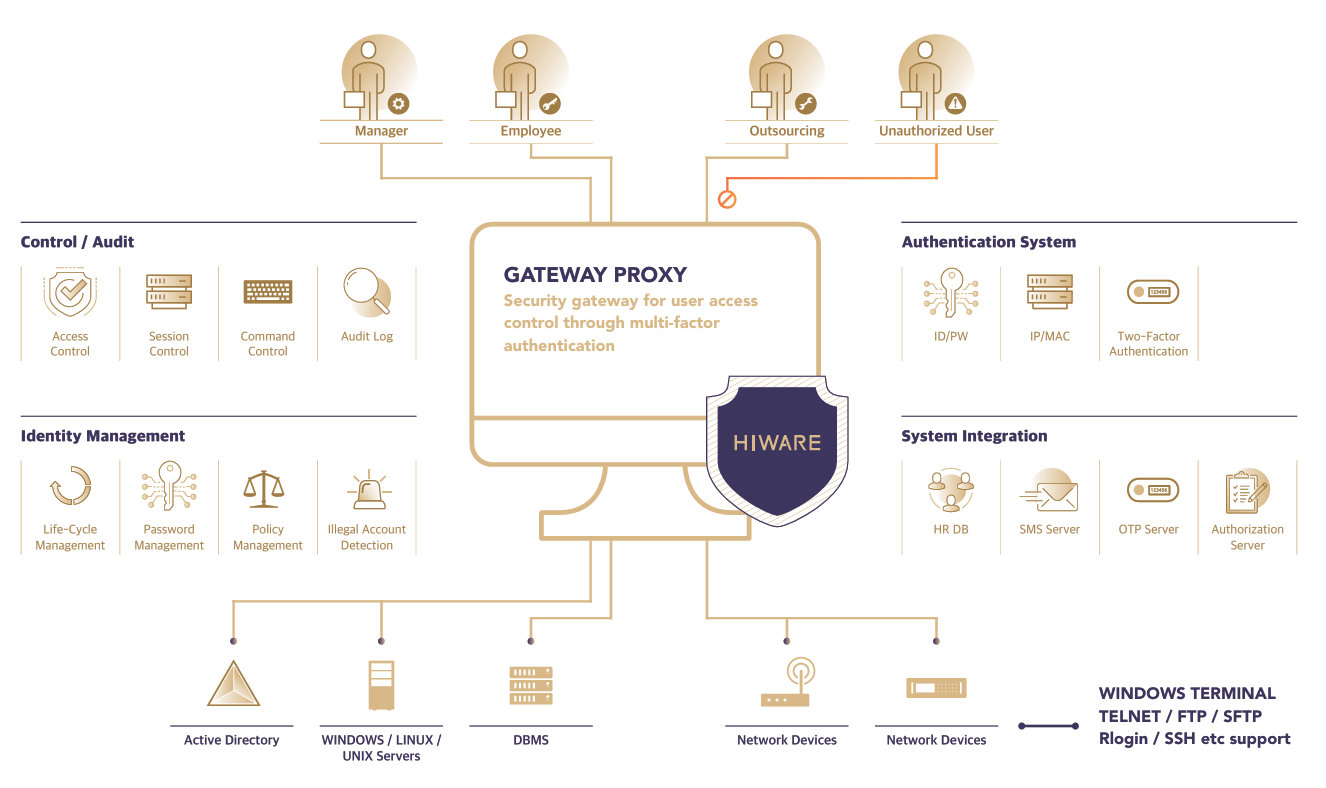
Integrated Identity and Access Management solution actively responding to next-generation security paradigm
NETAND HIWARE is an enterprise-grade Identity and Access Management platform combining IAM, PAM, PSM, DBAM, AD Identity Management and Mobile OTP into a single integrated solution. It enables secure privileged access, automated identity lifecycle management, real-time session monitoring, password management and policy-based access control across hybrid IT environments.
PSM for System – Privileged Session Management • IM for System – Identity Management • PSM for DBMS – Privileged Session Management • IM for DBMS – Identity Management • IM for AD – Identity Management • Threat Analytic – Artificial Intelligence to prevent an insider threats • Mobile OTP
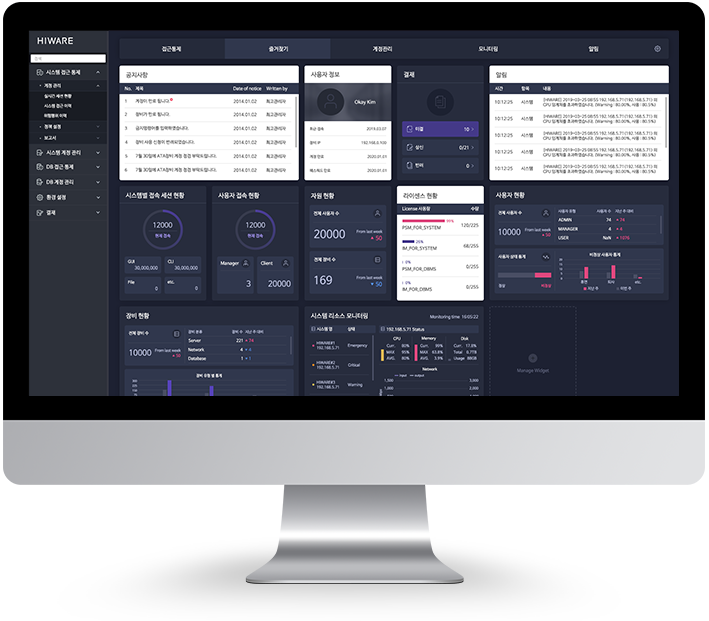
Priviledge Access Management
- Enhanced User Authentication
- Blocks unauthenticated IP/MAC address
- Support OTP authentication at solution login or individual system access
- Diverse authentication-linked APIs
- Diverse authentication combinations support(RSA OTP, Accredited Certificate, LDAP, etc.)
- Access Authority Management
- Manages each user according to the policy
- Centralized access authority allocation and management (access IP, access MAC, access time, 2-factor authentication)
- Diverse protocols support(Telent, SSH, FTP, SFTP, rlogin, Windows Terminal Service, etc.)
- Unifies all remote accesses
- Alarms the access and automatically blocks it when attempted by an unauthorized user
- System Command Management
- Command authority setting and control under diverse conditions such as group/ device
- Banned keywords(white-list/ black-list)
- Bans Telnet command and restricts leapfrog in case of a CLI-based server
- Warns and blocks the session as soon as a banned keyword is entered
- Immediately contacts the manager by text or email and requests approval when an important commnad is entered
- Manages all history of the commands use
- Realtime Session Management
- Realtime monitoring on ongoing sessions
- Sends a one-on-one message to users
- Auto blocking a session in the event of an illegal activity
- Sets work hours or idle time by the hour/ day/ date
- Blocks an overtime session
Identity Access Management
- Full and complete ‘integration’ and ‘managing automation’ are needed for easier and more powerful security.
- HIWARE Identity Management for System manages all user accounts scattered across systems in an integrated fashion by interworking a client’s HR system. It also automates the account and password management process for work efficiency and for more complete security.
- Account Life-cycle Policy Management
- Collects accounts of all systems and OS in HIWARE’s agentless technology.
- Improves security with SSH collection mode
- Provisioning management such as creation/ change/ deletion of accounts in batch
- Application and management of account policies in diverse ways
- Linkage with all systems and easy real-user synchronization
- Password Policy Management
- Automatic authority setting & password management on each user account
- Integrated management of passwords
- Auto-password change through scheduling
- Diverse creation rule setting and periodic password change
- Notifying the administrator of password change
- Change password before expiration
- Integrated Account Policy Management
- Integrated management after collection of accounts scattered across heterogeneous devices
- Management policy planning and customized management by account attribute
- Authorization with grant type for protocol, period, auto/semi-auto login
- Auto deletion of conventional authorities and mapping of the basic authority data of HR system such as reshuffle the personnel
- Detection of Retiree/ Inactive/ Illegal Accounts
- Regular check on the validity of user account
- Auto detection of threatening from ghost/ broken, inactive and locked accounts
- Detection of accounts with an expired ID/Password and auto-locking
- Auto locking and deletion of unnecessary accounts
- The locked account can be released after getting a permit from the administrator
Database Access Management
Secure Database Access
Privileged Access Management for DB
Manage and protect privileged access to databases, ensuring secure and compliant handling of sensitive data with automated controls
Main Features
- Enhanced User Authentication
- Strengthens access authentication by checking user IP/MAC/IP+MAC.
- Supports various additional authentication methods (Email, SMS, OTP, etc.) for user authentication.
- Possesses various authentication integration APIs.
- Supports various authentication combinations (RSA OTP, LDAP, etc.).
DB Access Control
Controls users based on policies, centralizes access control (IP, MAC, access time, 2-Factor authentication), and supports various DB systems (Oracle, MS-SQL, MySQL, PostgreSQL, etc.).Supports integration with commercial DB client tools without restrictions on type/version.Alerts unauthorized users attempting to access DBMS and automatically blocks access.
DB Query Control
Sets and controls query permissions based on various conditions by group/device.Applies prohibited keywords using the White-list/Black-list method.Issues immediate warnings and terminates sessions when prohibited queries are entered.Sends immediate notifications to administrators upon important query inputs, requesting approval.
Data Query Result Control
Cancels queries and terminates sessions for data requests exceeding a certain size.Automatically analyzes patterns to mask sensitive data (such as personal identification numbers) during query results.Cancels queries and terminates sessions if query response time exceeds administrative thresholds.
DB Work Log Records/Audit
Logs all work from the moment of DB access to logout.Manages all logs of queries executed during work.Provides a search filter to retrieve saved logs by user/system/date.Logs and provides text-based SQL query results.
Frequently Asked Questions
How do I design cyber security framework for my organization?
To define required cyber security in organization, one need to consider compliance & actual necessities. Compliance can be GDPR, DPDP, RBI, SEBI, IRDA, AICTE/UGC etc. Both requires data protection from internal and external threats + assets protection. More or less all cyber security framework suggests following steps:
1. Prepare: Define and implement comprehensive Cyber Security Framework. Define roles and responsibilities.
2. Identify: Understand compliance, requirements, problem areas and its solutions.
3. Protect: Implement solutions to protect digital assets.
4. Detect: In case of breach, identify impact, detect problem area.
5. Respond: On detection, how organization will respond to prevent any breach – define roles and solutions.
6. Recover: In case of breach, how organization will restore operations & prevent misuse of breach.
7. Report: Methods and tools to report to authority
Line of Defence:
1. CISO / Cyber Security Manager
2. Centrally Managed, Centralised Data Repository
3. Data Backup and Disaster Recovery
4. Firewall and VPN
5. VAPT
6. Data Leak Prevention, Encryption
7. Identity Management, Access Management, ZTNA
8. Anti Malware (with EDR/XDR/MDR)
9. Asset Management, Patch Management, MDM
10. Anti Phishing Simulation & Cyber Security Training